
 Back
BackPolitics in the Social Media Age
I joined Lewis Vaughan Jones on BBC News‘ The Context last week to discuss Andy Burnham‘s use of social media and the role it has played in building his political brand.
Social media gives politicians extraordinary control over how they communicate, allowing them to speak directly to millions without relying on traditional media. Andy Burnham has used that particularly effectively.
But political reputation can’t be built only in spaces you control. Television, radio, newspapers and podcasts bring scrutiny, difficult questions and audiences you may not otherwise reach.
The strongest political communicators need both.
Before the Spotlight

“Luck is what happens when preparation meets opportunity.” — Seneca
I’m writing this from Edinburgh, where the Fringe has once again turned almost every available corner of the city into a stage.
It began in 1947, when eight theatre companies arrived uninvited to perform alongside the newly created Edinburgh International Festival. They weren’t part of the official programme, so they found spaces and performed anyway. Nearly 80 years later, that open spirit remains at the heart of the Fringe.
We tend to encounter successful performers once the theatres are full, the reviews are glowing and everyone agrees they are brilliant. What we don’t always see are the smaller rooms that came first. The audiences that didn’t show up. The material that didn’t quite work. The producer who took a chance, or the feedback that helped turn something promising into something exceptional.
Artists need places where they can experiment, learn and find an audience. They also need people and institutions prepared to back them before success looks inevitable.
It’s been wonderful to see that happening with Pink Rabbit, written by Farah Ashraf, directed by my good friend Alessandro Babalola and produced by Daljinder Johal.
Some of their early performances have already sold out, so congratulations to the whole team. There are still tickets available for the remaining shows, which you can book here.
That’s one of the things I value about Soho Theatre, where I’m a trustee. For more than 50 years, Soho has championed new writing and emerging talent, connecting artists with audiences and reinvesting in the next generation through talent development and new commissions.
The connection with Edinburgh is particularly visible this month. Soho Theatre has brought 19 shows to this year’s Fringe across nine venues, while its team is also here discovering artists and work that could go on to reach audiences in London and beyond.
Someone has to spot potential before everyone else does.
It’s also part of the thinking behind PR Has Talent, which Graham Goodkind and I are producing at Soho Theatre on Tuesday 17 November. We’re looking for people across PR with talents their colleagues may never have seen, from singers and comedians to poets, musicians and performers.
We’ve also launched our new website. A huge thank you to David Olajide, Solomon Ibeh and the Curzon PR team, who have been supporting the project, with Curzon PR and Frank acting as our pro bono PR partner.
If you’d like to take to the stage, or know someone who should, email ThePRoducers@PRHasTalent.co.uk to apply.
Impact Beyond Borders
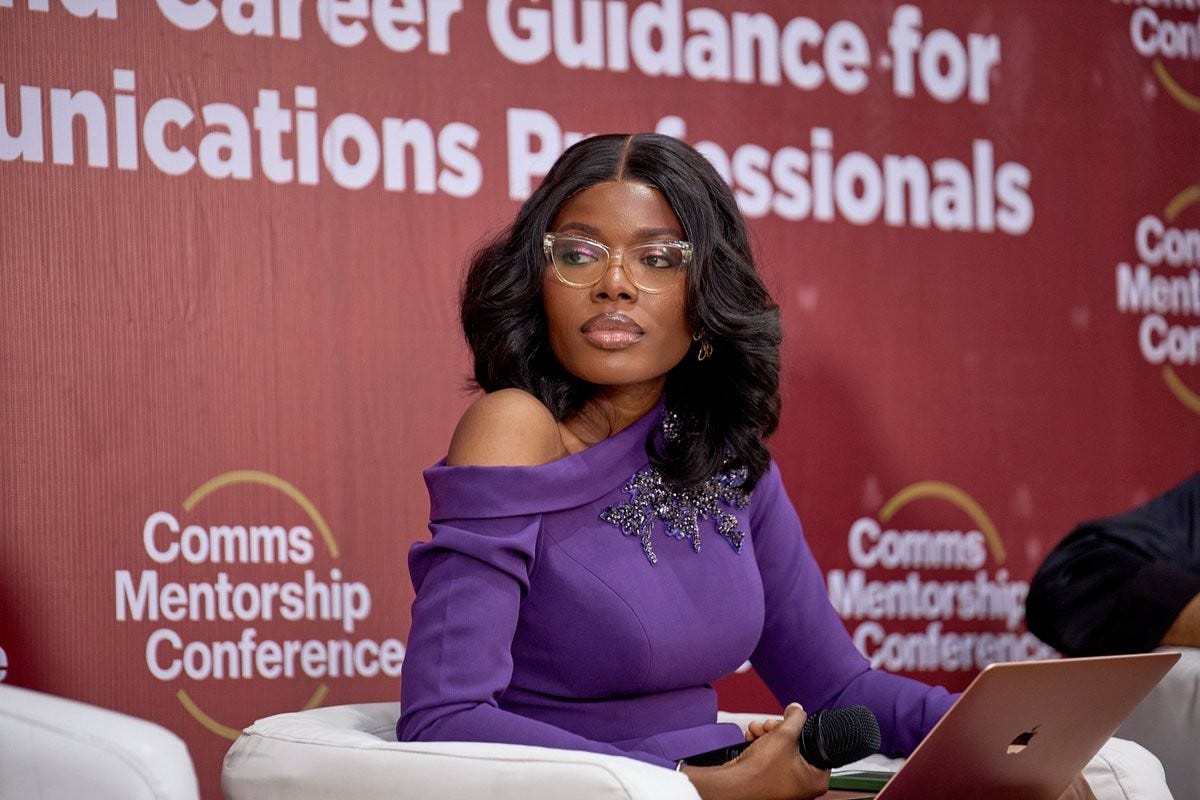
I joined Adedoyin Jaiyesimi this week for the launch of her CIPR Research Fund report, Impact Beyond Borders, exploring the barriers young African communications professionals face in accessing global training and professional development.
The numbers are worth paying attention to. Of more than 200 professionals surveyed across 11 African countries, 62% said the cost of global PR training was a barrier to their career development, while more than 40% said they lacked access to mentors.
Adedoyin proposes an ARC model (Accessibility, Relevance and Collaboration) as a practical framework for addressing some of these barriers. I was pleased to contribute to the conversation at the launch because the research raises an important question for our industry.
For professional bodies with a global outlook, the findings raise an important question about how we make training and development more accessible to professionals everywhere. There is a great deal of talent across Africa. Our responsibility as an industry is to make sure geography and cost do not determine how far that talent can go.
Read the full report here
Next-Gen

It’s A-level results week, and I’m delighted that my daughter got into her first-choice university. She is, understandably, over the moon.
My experience at her age was rather different. I failed miserably and lost my university place. At the time, it felt disastrous. Looking back, that setback took me down a very different path, and sometimes failing at something can turn out to be one of the best things that happens to you.
Which brings me to Matilde Eichberg, who has just graduated with First Class Honours in Public Relations from the London College of Communication, University of the Arts London.
In her graduation speech, Matilde spoke powerfully about the responsibility that comes with a career in media and communications:
“We do not live in a vacuum. Our stories are connected, our futures are connected, and our responsibility to one another is connected too.”
Careers rarely follow a perfectly straight line. There will be successes, wrong turns and setbacks along the way. After many years in this profession, it’s encouraging to hear someone at the beginning of hers speak with such conviction about the work and the responsibility that comes with it.
If Matilde and her fellow graduates are a sign of the generation coming through, the future of our profession is in good hands.
Do watch her speech here.
Influence Without Trust
I had an interesting conversation this week with Sophie Woollands who leads Campaigning and Influence at Woodrow.
Woodrow has just published its first Influence Economy Report, based on polling of 4,000 people across the UK, US and Kenya.
Only 0.2% of Britons surveyed said they trusted Andrew Tate. Yet when asked who shapes public debate and gets people to act differently, he ranked ahead of the Pope.
The gap between trust and influence is fascinating. We often assume credibility gives someone influence, but the two are increasingly pulling apart.
The research also found that people are more likely to act when someone explains the evidence clearly than because of their credentials. For leaders, the lesson isn’t to become louder or more provocative. It’s to make expertise easier to understand and harder to ignore.
Read the full report here.
How to Start a Career in PR
How to Start a Career in PR
When I moved into PR from accounting more than 16 years ago, I had no contacts, no media training and very little idea of how the industry worked.
David Gallagher came from a very different direction. He arrived in London from the US with years of PR experience, but still had to learn the nuances of British PR culture.
We’ve brought those two perspectives together to update and expand my guide to breaking into the UK PR industry. It covers everything from career routes and interviews to networks, pay and how AI is changing entry-level PR.
The industry can be difficult to navigate when you’re starting out, particularly if you don’t already have a network to guide you. This is the guide David and I wish someone had handed us on day one.
Thank you also to Mat Loup, Ann-Marie Blake, David Olajide and Solomon Ibeh for contributing their ideas and recommendations.
If you’re starting out in PR, or mentoring someone who is, you can read the updated guide here.
And a small cameo from Dante 🐶 in the video, who clearly wasn’t going to be left out.
When It Hits the Fan remains on its summer break. David Yelland and I will be back on BBC Radio 4 on 7 September.
Until next week,
Farzana
Originally featured in Substack